Sunday, November 13, 2011
Gallery visit 2
I was so happy to see that the Miro and Calder exhibit was still there. I must admit that i appreciate Calder's paintings but I am not a fan of his sculptures...although I understand he invented the mobile. The exhibit started with a huge Miro as you walked in. As you entered the exhibit the artwork was displayed in a hallway fashion. Calder's to the left and Miro's on the right. In the middle were Calder's mobile's. The walls were painted white because i believe there is so much color in both artists work that it would have taken away from the colors in the paintings. They were placed in a manner that the viewer could move from one side to the other and see the artists simultaneously. Calder's work is more known for his sculptures and Miro as a painter of Surrealism. I learned alot from the video I watched about Surrealism and Dada. Miro used postcards that he bought and recreated what he saw in that which is very hard to decipher , unless you understand what he was trying to do. Otherwise the shapes he made, that do have a meaning look just like colorful shapes. You can look at calder's abstract images and relate to what they are. I now have a better understanding. That is why I chose that exhibit. They are similar in the abstract ideals. They differ in the fact that Calder is more realistic than Miro about his. You really have to look at miro's to understand what he is portraying. I really like the way they showed the art. You could move from one side to the other of the room. I think they were trying to show the complimentery of the two. I will always be a fan of Miro...however...I have an admiration of Calder now as well.
Thursday, November 10, 2011
week 11 video blogs
I have always been very interested in Picasso and Matisse and was excited to see a video about them both. I didn't know they were such good friends. Like our book the video explains the differences and similarities between the two. I definitely understand both much more. The video describes the nature of both men, like our book, describing Matisse as organized and Picasso as "flighty" . These personalities are apparent in their works. The video further explains how the artist created his work, Matisse with a plan, an idea, and Picasso just doing whatever came to his mind, emerging himself in the piece. We learned about Cubism through our readings, the cutting up of images, introduced by Picasso. Also the calm,beautiful effects of Matisse' works. The video showed the progress of each artist side by side and the tauntings of eachother, as well as the borrowing of styles from eachother. I really enjoyed the play between the two art giants, how well they got along although they were complete opposites, how each one pushed the other with their new ideas. Both needed anguish in their lives to create their masterpieces. Matisse kept his inside and only painted beautiful things to make people happy and Picasso painted the world as he saw it, beautiful and ugly. Matisse always needed a model when painting his Odalisque series and Picasso rarely used a model, getting his image from his memory. Picasso didn't want to paint realistic things, he wanted to remove the viewer from his world and force him to enter Picasso's. Matisse was nearly a recluse and Picasso very flamboyant, in need of attention but somehow the two remained great friends until Matisse's death in 1954. I didn't realize that Matisse's later works were actually collages because he couldn't paint any longer. It is significant to me because Picasso invented the collage, they came full circle together.
Because I had learned so much about Picasso and Matisse I wanted to learn more about the next movement, Dada and Surrealism, but got more than I bargained for because this video highlighted 6 different artists. All shared the common idea that art should imitate itself, stand on it's own, not a representation of anything real. Dadaists believed in finding nonsense with everything, as we learned in our reading. The book mentioned Hannah Hoch, who was one of the featured artists in the video but I learned alot about her and her movement from the video. She was the founders girlfriend and ended up being the most influential Dadaist. She invented the photo montage and spoke volumes about her distaste of the world around her through this media. Not only are her pictures a mockery of evil persons in power they are also a history of the times she lived in. I hadnever heard of Kurt Schwitters but recognized his "house in a house", a collection of things he had acquired to be shown in his house and how he chose to display them. Both movements weren't really movements at all, as the video and book both explained, but rather a feeling. Dadaists were playful, almost absurd. Surrealists were more focused on the dreams and psychlogical interpretations of people. They would create pictures of realistic and natural objects in unnatural settings, causing the viewer to make sense of the painting. Two of the most famous Surrealist artists were Joan Miro and Salvador Dali, both learned about in our readings. Miro's paintings were colorful, playful shapes of realistic items put together in such a way they are almost indistinguishable. Dali's work is macabre, dark, eerie. He wanted to delve into the psyche of the human mind. Although his subjects are more recognizable he distorts them in such a way that the viewer is left to try to figure out why.
I remembered from our quiz that Georges Seurat created pointillism but didn't really know much else. I have seen his painting A Sunday on La Grande Jatte-1884 a million times but never put the name with the work. I learned so much from this video. I had no idea there was so much controversy surrounding it. It's meaning or theme is constantly argued about. What do the women signify, the monkey, the fishing pole. Where these hints during the time it was painted towards the women being prostitutes, as was famous on the island at the time he painted it, or just mere ladies enjoying a leisurely Sunday. Did he intend for the "dots" to blend completely or not? Our book touched on him slightly, describing his techniques with conte-crayon to achieve texture and his use of light for dramatic effects. The video focused more on his pointillism technique and what he achieved with that, I love there is so much controversy about it. Not only is it an amazing impressionistic painting but it is also a departure from that and an invention entirely his own. Unfortunately, his career as a painter lasted only 10 years as he was struck with diptheria and died at a very young age. It would have been great to see what other inventions he may have created.
The fourth video I watched is The Mystical North. This video displayed tons of artists in our book. Goya, valesquez, Dali were all mentioned. They were the forefront of modern art. A pleasant surprise was Gaudi, the architect. I know that our culture uses the word gawdy to explain something that is too much or not right, however, we use the word and explanation incorrectly. His designs are amazing and modern before their time. I didn't know that Picasso ever painted religious paintings, but learned from this video that he designed his own museum and gave tons of his work to it. I also learned that Dali built his own crypt , in the way that he would , and is buried underneath. I would love to go see both. I was most impressed to learn about gaudi as I have already learned Miro, Picasso, Goya and Valesquez. I do believe Spanish painters don't get the recognition they deserve. They were the start of modern art. Goya with his "Black Paintings", which were called so due to the use f black paint and disturbing images, Gaudi who was commissioned to design a cathedral during a time when religion was changing, and Dali who didn't follow anyone. What an amazing group of artists.
Sunday, November 6, 2011
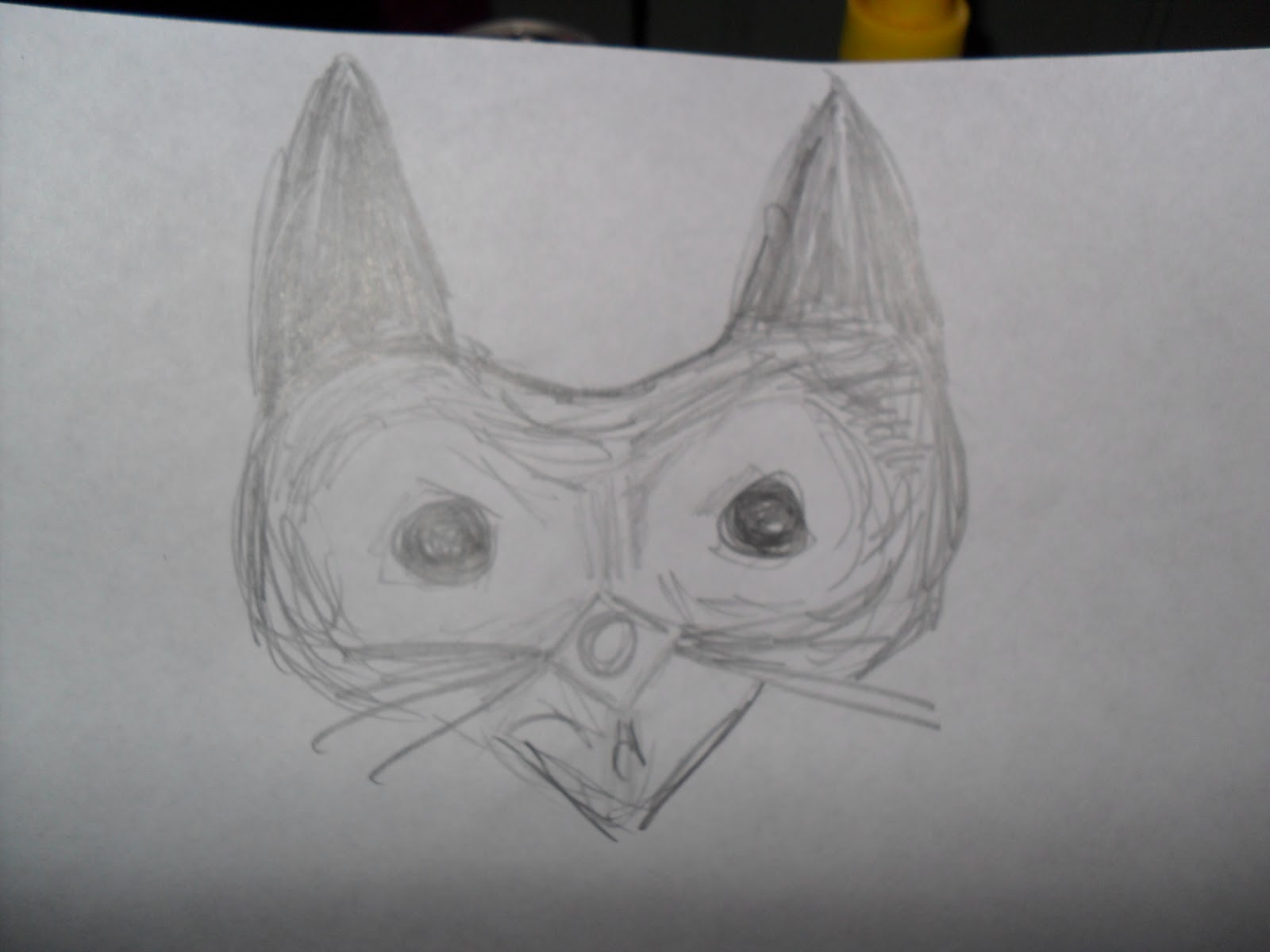
Mask
Thursday, November 3, 2011
week 10 video blog
I was very interested by our readings about African art and I believe I am going to use their ancient culture for my extra credit so I chose both the videos about African art to write my blog. The first video I watched was African Art: Legacy of Oppression. I was at first amazed by the huge amount of African artifacts in the Belgium museum until I realized how they were acquired. I didn't even know the devastation incurred by the Africans at the hands of the Belgium people. Congo , in central Africa, was the biggest massacre during the holocaust...10 million people killed....and I never heard a word about it. King Leopold wanted the area for himself to make a profit from the rubber that grew wild there and used it's inhabitants as slaves to get it. He also admired their art and took it from them and brought it back to Belgium to be displayed during a fair...along with live Africans whom he displayed like oddities or animals. Our readings touched on a lot of facts I learned in the video. The Africans had many different forms of art...the museum alone houses 250,000 pieces from 250 cultures. One such form of art is called "Magical Art" and it was used to show respect towards mothers or chiefs. It was also used to show revenge or to invoke fear. The most common "Magical Art" were masks, as our book described very well. Africans would wear these to tell stories or explain maladies of the wearer, or invoke fear to those who saw them. Most of the artwork was very abstract, telling the viewer what needed to be said with very little or in an obscure manner.I was saddened by this video to learn the hardships these people endured but also learned alot about the meanings behind their artwork.
The second video I watched was African Art: It's cultural Meaning. It, like our book, described the tradions behind African art and how they were used in ceremonies or rituals or everyday life. All African art has a meaning or purpose behind it. Whether it is a sculpture or haircomb or mask it was made to represent something...either a king or ancestor or spirit. The Africans weren't just making representations of these but actually bringing the dead back amongst the living. The only art that actually resembled the subjects were those made of kings. All others were abstract and shouldn't represent an actual living thing. This is done in a conceptual way...what the artist sees rather than what is really there. This type of art influenced Western abstract artists like Picasso. I learned from the video more of the techniques required when the Africans make their artwork...traditions must be followed. It is okay to deviate or embellish the piece but the piece must be created traditionally first to keep the traditions of that culture alive. A great artist is one who can make the piece traditionally but better than other artists. Masks are worn for many reasons and are but one part of the ritual. Music, costumes and dance are also part. When a person dons a mask they are giving up thier individuality and becoming one with the spirit they are trying to get in touch with. The traditional art of Africa is still being created, however, in some areas it is being produced for the International market for profit rather than rituals but this is keeping the skills and traditions of the African past alive.
The third video I watched was Buddhism: Heaven on Earth. There was alot of information in this video that was also in our readings, such as how Buddhism was born after the prince Siddhartha Guatama saw the real world with all it's suffering and questioned 'is that all there is" and seeked to find an answer. That answer was that if we continue to desire things we will never be enlightened and awake and will continue in the cycles of life and death until we are enlightened. The video talked a bit more about this by explaining Buddha's ideals ...how he didn't want to be seen as a god but simply a messenger of his belief. He knew that "some will understand" what he was saying...and he was right. The architecture of the Buddhists tells a story and has a meaning at every level. The lotus flower is the symbol of Buddhism and is used to decorate the temples or even as the shape of the temples. The carvings around the Buddhists temples do not show Buddha but symbols of him for he is no longer here. The architecture is simple yet extravagent. The largest Buddhist temple is Borobudur in Java, Indonesia. It took over 100 years to build and was a pilgirmage of Buddhists for only 60 years before it was covered by a volcanic eruption. It has since been uncovered and restored and is still a mecca for Buddhists pilgrims. Another aspect of Buddhism I learned from the video is that Buddhism is embraced everywhere but India where it originated. And the teachings of Buddha-there should not be a personal god or rituals or prayers or questions-are all now embraced in Buddhism. However the true meaning still exists...you must find your own path to enlightenment, now Buddhists just have mentors and helpers to find it.
Because the video about Buddhism mentioned that Hinduism replaced, for the most part, Buddhism in India I wanted to learn more about it. Although quite different the two have many similarities. As mentioned in our book hindus also believe in the cycles of life. Both also believe in treating everything kindly. However Hinduism belief is that your freedom will be granted by a god only after your devotion. Hinduism has many gods for different purposes. The video explained this further by explaining the gods that are primarily worshiped. Also the place of worship is important because they represent different gods, such as the Ganges River in Varanasi, India. This river is in the oldest inhabited city in the world and is thought to be the Mother Ganges, the female part of the god Shiva. A temple in Khajuraho, India is home to a temple for Shiva, giver of life. Hindus flock there to receive the life-giving forces of the lingan, a phallic symbol representing Shiva. All the gods in Hinduism lead to one thing, Brahma, who can grant you eternal life through reincarnation. This video taught me alot about the two "religions" of India, born of the same idea but worlds apart.
Wednesday, October 26, 2011
Hand drawings
I was very apprehensive about this at first! I have tried in the past to draw my hands and became very frustrated and gave up. I must say that this time was much more successful. The shading of the lines and the shadows were difficult at first but I just stayed with it and tried different techniques. I chose pencil because I have worked with charcoal before and seem to get more on me as my arm and hand drag across what I am drawing, however I had to add many layers to the pencil drawing to get the darker lines. I am horrible with my left hand, although I do drive with it...but that's it! I was very unhappy with the rendering of my right hand. I couldn't make straight lines, couldn't shade within the lines I made and basically had no control of what was being drawn. I will definitely not use my non-dominant hand again by choice. I like the realism I achieved with my dominant hand. I think the shape is pretty good. I would like to become better at creating the shadows and the shapes that make them but overall I was pretty happy. What is there to say about my non-dominant hand drawing except it is awful! I couldn't shade properly or even create a believable outline. My nails look more like stamps! Not happy at all with it!
Tuesday, October 25, 2011
Week 9 Video Blog
I chose the video about Michelangelo as my first video. I have seen a few of his drawings but didn't know so many existed as he is better known for his sculptures and the Sistine Chapel. I wanted to know more about his drawings. I didn't know he taught himself to sculpt...wow....and just look at the masterpieces he created. The video related to our readings through discussion of his sculpture David and the frescoes of the ceiling of the Sistine Chapel. The video showed a poem he had written describing his distaste for the project and the book tells us he hated painting and there is a verse from the poem on page 371. I didn't know he was such a prolific architect as well. He designed the interior of the Medici families tomb, including the furniture, and also created the framework of the Sistine Chapel's ceiling to better show his different scenes. I certainly learned alot about the final works we know so well after watching this video. I am amazed to see the sketches and beginnings of such masterpieces. His knowledge of the human body is incredible...even when quickly sketched by him. What a genius.
I was interested in Albrecht Durer when I read his profile in our book on page 177 so I chose the video about him to learn more. I was very drawn to his woodcut Four Horsemen of the Apocalypse on page 176. How can someone have the talent to create such a delicate and intricate woodcut? I was very happy to see many of his other prints in the video. I learned he is considered the first landscape artist in Europe and that he got his inspiration from traveling to Italy, where he spent alot of his time. Both the video and our readings describe how he would create his works with a combination of Northern features and Southern features. He would include naturalistic figures as well as idealized beauty in his paintings. He made most of his money from the sale of his prints but was also appointed the court painter of the Holy Roman Emperor Maximilian I. The book and video mentioned his arranged marriage and the video showed drawings he had made of her. I really enjoyed the video because I was able to see how his artwork changed throughout his years. He was talented in so many different aspects of art and his work trully revolutionized Renaissance art, which means "rebirth" and was a revival of ancient Greek and Roman culture.
I didn't know anything about Valazquez and therefore wanted to watch this video to learn about him. I am glad I did! He was a Spanish painter during the Baroque era. He was the appointed court painter of King Philip IV of Spain and who was also, according to the video, his only friend. He painted many portraits of the Royal Family but had his own unique style...somewhat Baroque with his use of light and space but also very independent of any other art movement. He wasn't interested in creating pleasing works of art but rather "real" works. He was able to capture the true spirit of his subjects. His most famous works were of the court jesters with whom he spent much of his time. These pieces are called the Baffoon Portraits and they captured the opposites of Baroque, the beauty and opposite of Baroque, the flaws. He painted the person just as he was, with his flaws apparent, but was able to give his subjects a transport from their daily lives to rise above their afflictions. He was able to capture the "human" in his renderings. Both the book and the video gave alot of detail of his most famous piece Las Meninas, which is a painting so involved but yet so organized due to his genius in the organization of his paintings. I really like Valazquez' work and can't believe I didn't know anything about him until the book and this video.
I chose Leonardo Da Vinci: The Mind of the Renaissance as my last video. Although he was a painter, most famous for The Last Supper and the Mona Lisa, I am amazed by how many other things he undertook. His drive to understand everything around him was unstoppable. The inventions of things we use today like the submarine and airplane were just a bit too early to be executed then. He was so well-rounded but after watching the video I don't think he ever gave his intellect enough credit. As with every video we have seen a particularly like to see the not-so-famous works of art. I didn't know that there weren't many of his paintings remaining, nor did I know he left most of them unfinished. I had never heard that he was looked over twice by the King to become the new court painter, losing the position first to Botticelli and then Michelangelo. He was forefront in a particular technique of combining different parts from different people to create one true beauty, the perfect man. Perfection and beauty were embodied in the Renaissance Period and Leonardo found a way to acheive this. I liked this video but it seemed to say to me that Da Vinci may have led a sad life which is something I never would have figured given he was so talented.
Tuesday, October 18, 2011
Week 8 video discussion
In the video More Human than Human I learned alot about human psyche and how it relates to the ways we make and perceive art. I think it's fascinating that we are drawn to exagerrated images and we don't know why. I didn't realize that the Egyptians maintained the same human form drawings for 3000 years...that's mindboggling! The video related to the readings by talking about the Egyptians and the continuity in their artwork. Also the Greeks and their temples and sculptures were found in the readings and explained even more in the video We even have a picture of the Greek bronze Warrior sculpture,which was found by an Italian tourist, on page 335. Our book talks about the venus of Willendorf and what her purpose may have been and the video took it a step farther, trying to explain other reasons she may have been carved, such as our fascination with exagerrated features of the human form that may very well be hard-wired in our brains. I really enjoyed this video and learned more from this one than others I have watched. I only wish it would have been longer!
I chose Cataclysm: The Black Death visitsTuscany as my first video because I knew a little about the plague but wanted to know more about it and how it affected the art of the times. Until this video I never thought about the religious implications the Plague would have or that it would change the artists depictions of religion. It makes perfect sense now that these would have been the major outcomes of such a devastating event in such a religious era. It was interesting to learn that these two major cities had such an enormous uprising and even more dramatic fall due to debt incurred from just trying to maintain the growing population. Two of the artists talked about in the video are also mentioned in our readings; Duccio from Sienna and his contemporary from Florence Giotto. Our readings described their use of space in their paintings...the placement of the walls and people giving movement to the artwork. Duccio's use of architecture to dictate space rather than a backdrop and Giotto's faces full of emotion were the two major contributions given by these artists. Both were alive before the plague and the video gave us more information of their views through their artwork after it. I liked this video because it explained the artwork and how it had changed due to different events but it didn't focus only on the artwork produced but also why it was produced. I learned from this video that many inventions arose from the Renaissance period: modern cities, modern banks, universities, eyeglasses fireplaces and paved roads. I also learned that the vanishing point was developed in the 1400's...what that must have done to the artworld!
My second video is The Greek Awakening: Art from the 5th century BC. I have always admired the Greeks and all the accomplishments they created that we still implement today. This video touched on many of them...art, science, philosophy, math and politics. I was hoping this video would provide more information on the architecture of the Greeks because I knew from our readings that not many paintings during this period remain...and it did. I am sad, however, that there aren't many paintings to study. Although I am amazed by architecture I feel I learn more about a culture through it's paintings. I learned both from the readings and this video that Perikles basically turned Athens from a city of wood to a city of marble. What an enormous feat that must have been! And what a testament to Phidias, Pericles friend and overseer of the Acropolis' construction, that it still stands today. Both the video and our readings informed us that there are no straight lines in the Parthenon, though we can't tell by looking at it...they planned it that way. I enjoyed the indepth explanation of the sculptures around the frieze of the Parthenon. It is amazing how much thought went into what they placed where and for what reasons. I wouldn;t have known what a frieze was if I hadn't learned it in our readings! This video renewed my life-long dream to go to Greece! I loved how the people and their culture are portayed in the video...as alive and vibrant as those centuries earlier and just as integral to the history and future of Greece.
Cairo Museum is my third video. There wasn't much that related to the readings except a few explanations of what the art meant and where it was found. There was a mention of King Tutankhamun's tomb in the readings and more in-depth explanation on the video. 3500 objects were found in King Tutankhamun's tomb...wow. I did learn from the readings that his father tried to change the style of art in Egypt, as well as their religious beliefs, but this didn't last. This video was still extremely interesting to me, however. I can't even begin to imagine how difficult it would be to choose which artifacts to display, especially when choosing from 80,000 of them. The basement houses these artifacts...as many as are in the museum itself. one piece I really liked was an ivory carving of a gold fish that was used to mix cosmetics that dates back 3000 years. It is great to see the colors and gold and jewels they used. I would really love to visit this museum.
Subscribe to:
Posts (Atom)